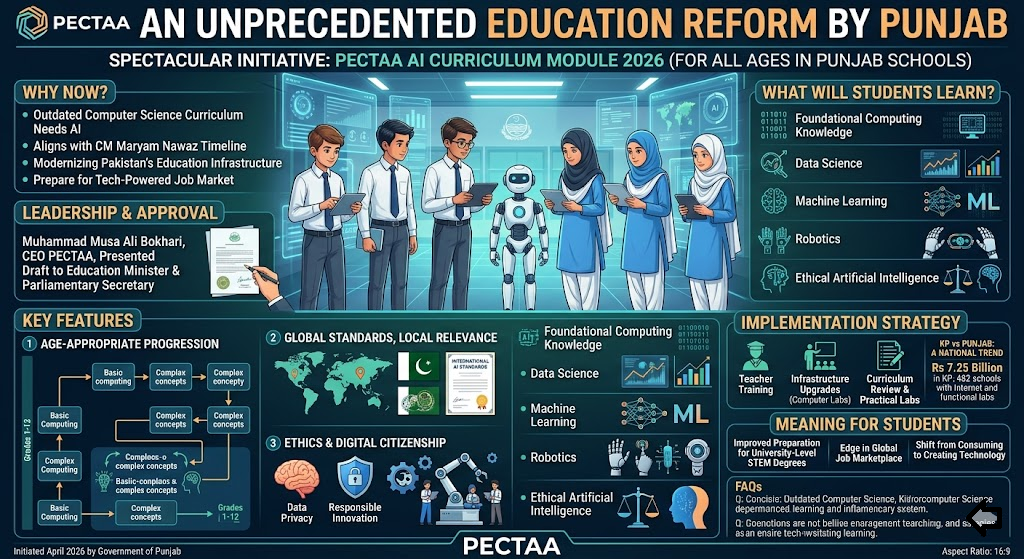
An unprecedented education reform by Punjab In 2026, the Punjab Education, Curriculum, Training and Assessment Authority (PECTAA) initiated a premier program in the province’s history by institutionalizing an Artificial Intelligence (AI) course module for residents of Punjab schools. This is more than just an update to existing computer science classes. It is a comprehensive overhaul of how pupils in Punjab will learn, think and compete in a tech-powered world.
What Is the PECTAA AI Curriculum 2026?
This Punjab Educational Curriculum and Training Agency (PECTAA) AI 2026 with progressive age-appropriate stage-wise broad objectives and a challenging educational program is designed to introduce pupils of all ages in Punjab to the basics through complex ideas of this vital discipline.
Courses are offered for a variety of subjects, some of them are:
- Foundational computing knowledge
- Data science
- Machine learning
- Robotics
- Ethical Artificial Intelligence
Note: PECTAA CEO Muhammad Musa Ali Bokhari personally presented the first draft to Punjab’s provincial education minister and parliamentary secretary — a clear indication of the seriousness with which the government is taking digital education reform.
Why PECTAA Launched This Initiative Now
The timing is deliberate. Chief Minister Maryam Nawaz had defined a clear timeline for integrating digital education across Punjab’s school system, and PECTAA has delivered in that period. The project is part of a larger national push to modernise Pakistan’s education infrastructure, ahead of the next wave of technological disruption reshaping the job market.
The outdated computer science curriculum, according to officials, just did not include core A.I. concepts — particularly for sixth- through eighth-graders. This gap has left Punjab’s students unprepared for higher education or the modern economy.
Key Features of the AI Curriculum
1. Age-Appropriate Progression: The curriculum sets out the steps by which AI concepts, or lack of them, can be introduced based on a student’s grade and learning ability — basic computing in the earlier classes and moving to concepts like machine learning in higher grades and robotics as well.
2. Global Standards, Local Relevance: The framework combines internationally-recognized AI education standards with the needs of local Pakistani students. That ensures skills developed are applicable globally, but grounded in local context.
3. Ethics and Digital Citizenship: It’s one of the major features on which it stands out, and advanced responsible use of AI. Students will be taught data privacy, governance for A.I. and the social implications of technology — allowing them to become ethical innovators instead of just technical users.
4. Creativity and Problem-Solving: It’s not just coding and theory, the curriculum focuses on creativity, innovation and real-world problem-solving — skill sets that are in ever-increasing demand from employers all around the world.
Punjab vs Khyber Pakhtunkhwa: A National Trend
Punjab is not alone. Similarly, KP has also updated its computer science curriculum with content on AI from Grades 6 till 12. The programme is expected to cover new computer labs, teacher recruitment, upgrading IT infrastructure and developing online artificial intelligence (AI) learning platforms which KP officials estimate will cost about Rs 7.25 billion to implement. Under the KP plan, 325 dysfunctional IT laboratories will also be made functional and482 schools in Khyber Pakhtunkhwa (KP) would have internet access.
Note: This is a national agreement: AI education in Pakistani schools is not optional — it’s now an imperative.
Challenges That Must Be Addressed
Whether the excitement translates into action is complicated by significant challenges to implementation, experts and officials say.
- Teacher Shortage: Teacher Shortage KP has a shortfall of over 7,500 IT teachers — needed number is more than 10,600 while the available figure stands at just 3,050. Punjab faces a similar challenge.
- Infrastructure Gaps: The State of Computer Labs and Internet Access in Schools
- Curriculum Updates: Technology evolves fast. The curriculum needs to be reviewed and amended periodically for relevance.
- Practical Learning: Students require hands-on labs, access to real datasets, software and project-based learning — not theory alone.
Note: these hurdles are handled will dictate whether this effort graduates out of the policy cage k.
What This Means for Students in Punjab
This curriculum shift offers real opportunities for students in Punjab’s school system today:
If you are asked to create a sentence without giving any hint about the words needed, it may look as strange sentence as this.
- Improved preparation for university-level STEM degrees
- Edge in the domestic and international job marketplace
- Skills correlated with the fastest growing employment sectors around the world
Note: The aim is to shift Punjab’s students from consuming technology, to actually creating it.
Frequently Asked Questions (FAQs)
Q: What is PECTAA AI Curriculum 2026?
So, what is PECTAA (Punjab E- Centre for Technology and AI Pedagogical Academics)? Well, it’s a structured AI education framework for Punjab schools, that comprises of data science and machine learning robotics and ethical AI — released by PECTAA in the month of April 2026.
Q: Who is behind this curriculum?
The curriculum was designed and introduced by were Muhammad Ali Bokhari, Chief Executive Officer of Punjab Education, Curriculum, Training and Assessment Authority (PECTAA).
Q: What are the grade levels for your AI curriculum?
The curriculum is structured progressively for multiple grade levels, with basic content for younger students and more advanced AI topics as you move to higher grades.
Q: Are all Punjab schools carrying this curriculum?
The rollout is ongoing. Implementation of it across the province has been mulled after which the first draft received approval.
Q: Are any other provinces introducing AI education?
Yes. Khyber Pakhtunkhwa has further updated its curriculum for Grades 6-12, prompting the roll-out of AI education with an allocated budget of Rs 7.25 billion for complete implementation of instruction.
Final Word
A monumental reform in education history of Punjab- The PECTAA AI Curriculum 2026 If it is bolstered by sound investments in teacher training, infrastructure and hands-on learning tools, the initiative could yield a generation of not just tech-savvy but also globally competitive Pakistani students.